Skip to content
Diego VolpattoLNCC / MCTI
PTEN
Menu
  • About
  • Research
  • Publications
  • Software
  • Teaching
  • Supervision
  • Research groups
  • Collaborations
  • CV
  • Curiosities
    • Academic genealogy
    • Musical adventures
  • Contact

Research

Numerical methods & porous media

Discontinuous, hybrid and stabilized finite element formulations for flow in heterogeneous media.

I investigate multiscale problems, hydromechanical coupling and double-porosity and double-permeability models, with applications in rocks and reservoirs.
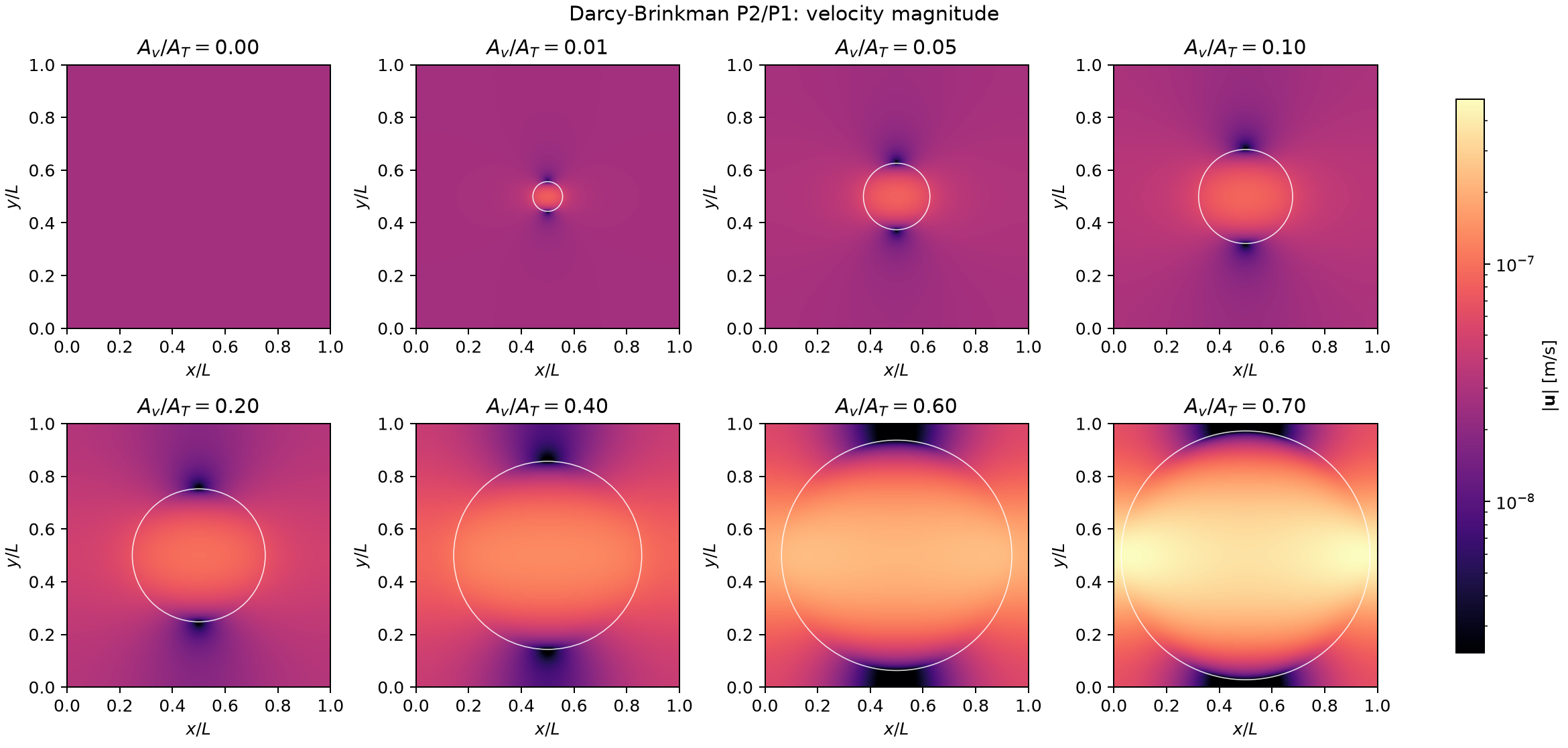
Eight velocity-magnitude fields in a square domain, with circular cavities covering area fractions from zero to 0.70.
Darcy–Brinkman flow in a porous medium with a circular cavity: velocity magnitude for different cavity area fractions. A synthetic voids example solved with P2/P1 finite elements.
Source: voids documentationView full-size figure
Related software: voids

Computational thermodynamics

Phase equilibria and thermophysical properties, using equations of state, activity-coefficient models and fitting to experimental data.

Applications include PVT properties of petroleum fluids, CO₂ mixtures and biofuel flash points. In the context of the energy transition, thermodynamic modeling also applies to carbon capture, utilization and storage (CCUS) and underground hydrogen storage (UHS).
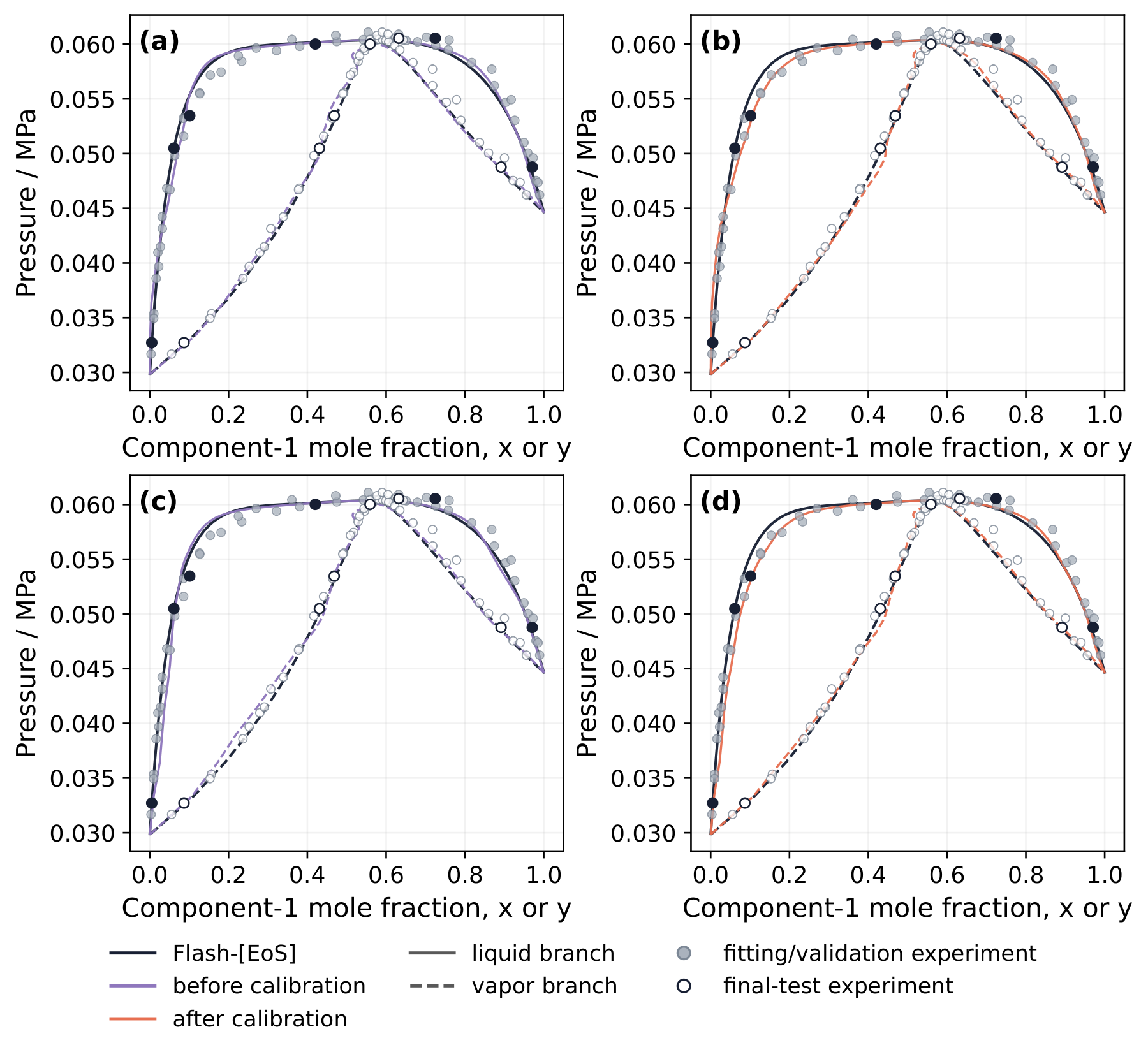
Pressure–composition diagrams for methanol and benzene, comparing two neural-network models before and after fitting experimental data.
Methanol + benzene vapor–liquid equilibrium at 318.15 K from the GibbsFlashNN study. Panels compare Balance-Preserving FlashNN and GibbsFlashNN before and after experimental calibration. Solid and dashed curves represent the liquid and vapor phases; points show experimental data.
Source: GibbsFlashNN studyView full-size figure
Related software: torch-flash

Scientific machine learning (SciML)

I study how to incorporate physical information into machine learning and integrate learned models into scientific simulations.

On-demand learning

Reusing equilibrium states and sensitivities to accelerate calculations during simulation. New full evaluations are performed when an approximation fails the acceptance criterion.

Reactive transport study with ODML

Hybrid thermodynamics

Neural models with material balance preserved by construction and training guided by thermodynamic relations such as Gibbs–Duhem. Applications include flash calculations and flash points.

GibbsFlashNN study

Numerical methods and physical information

Coupling learned models with solvers, including neural constitutive relations and automatic differentiation. I assess accuracy, physical residuals and computational cost against reference solutions.
Differentiable thermodynamics tools

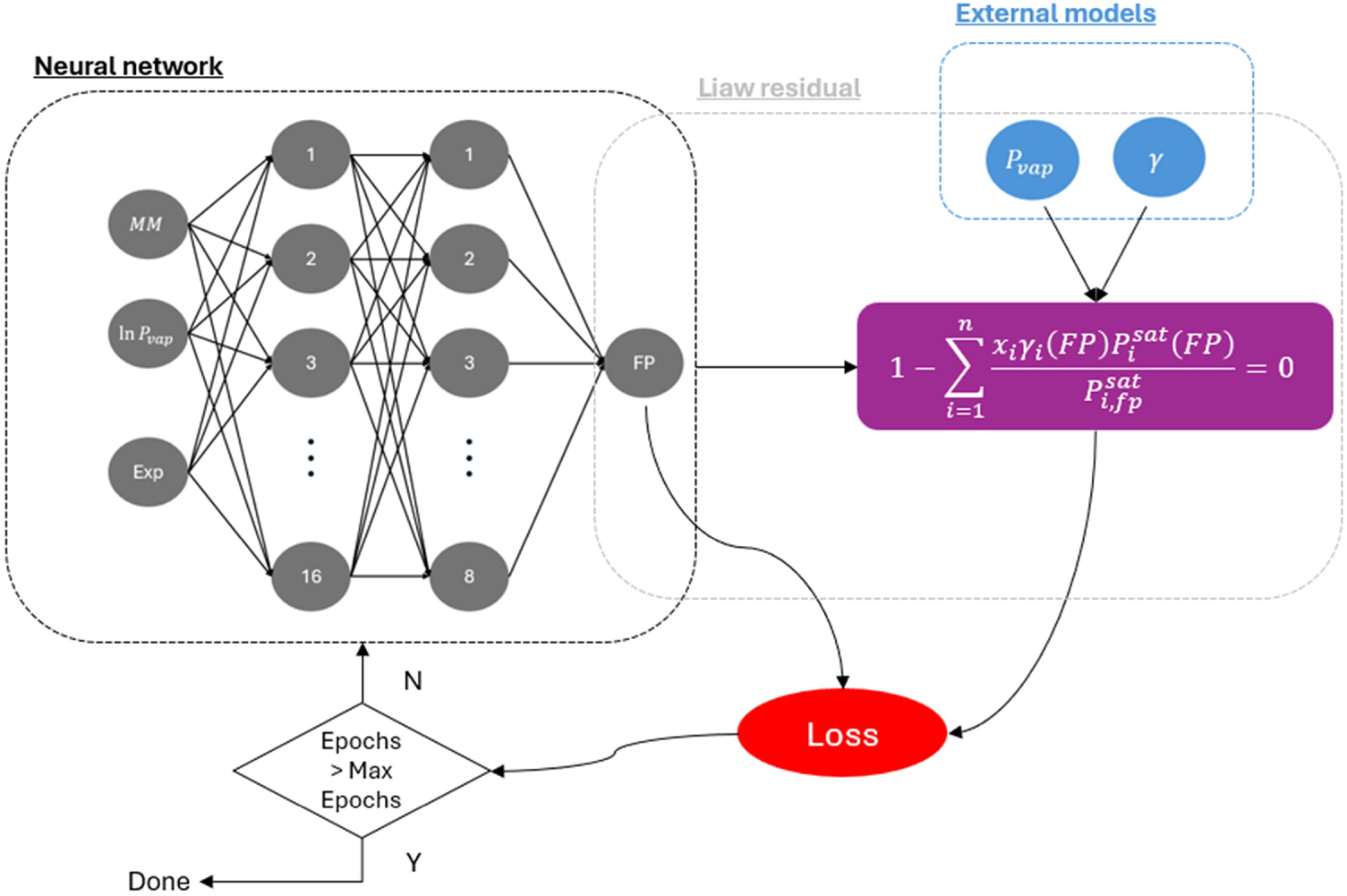
Diagram of a flash-point neural network: its prediction and vapor-pressure and activity-coefficient models feed the Liaw-equation residual, which enters the training loss.
Flash-point neural network trained with the Liaw-equation residual. Vapor pressure and activity coefficients are supplied by thermodynamic models. Figure reproduced in full, without changes.
Souza, Volpatto, Barbosa Neto and Costa (2026), Fig. 3CC BY 4.0View full-size figure

Reactive transport & geochemistry

Coupling flow, species transport and geochemical reactions in heterogeneous porous media.

Studies integrate Reaktoro and Firedrake to track fluid composition and mineral dissolution and precipitation.
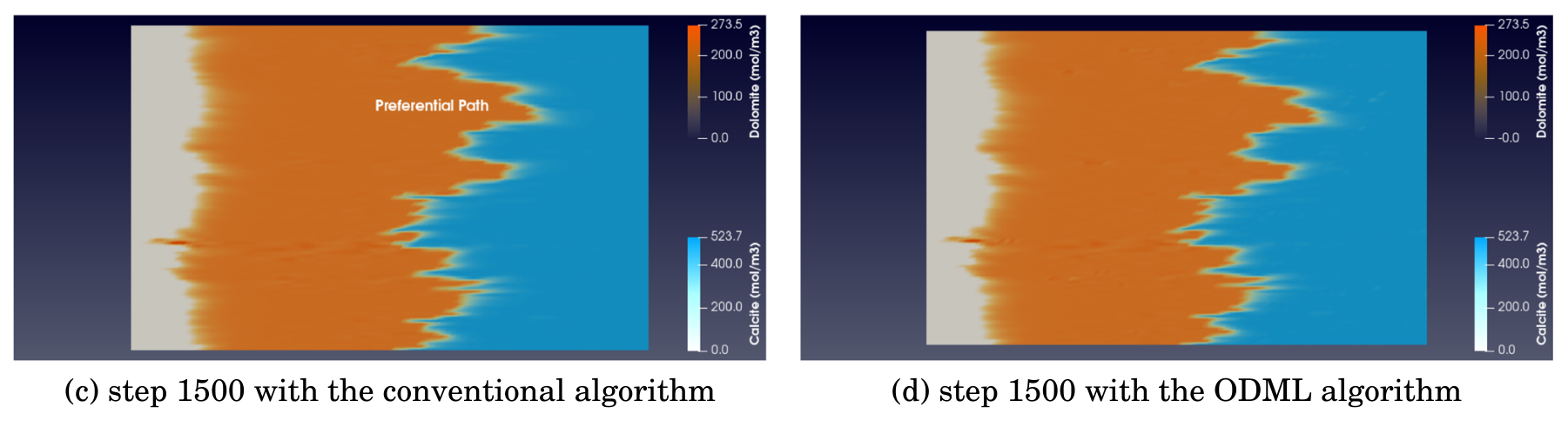
Calcite in blue and dolomite in orange, comparing the conventional algorithm and on-demand learning in a heterogeneous porous medium.
Calcite and dolomite during a reactive transport simulation: conventional calculations on the left and on-demand learning (ODML) on the right. Both fields correspond to time step 1500, about 1.43 simulated days.
Kyas et al. (2022), Fig. 3(c–d)CC BY 4.0View full-size figure

Inference & uncertainty

Bayesian calibration, sensitivity analysis and uncertainty propagation in computational models.

I study parameter identification from observations and its effects on predictions, with applications in dynamical systems and epidemiological models.
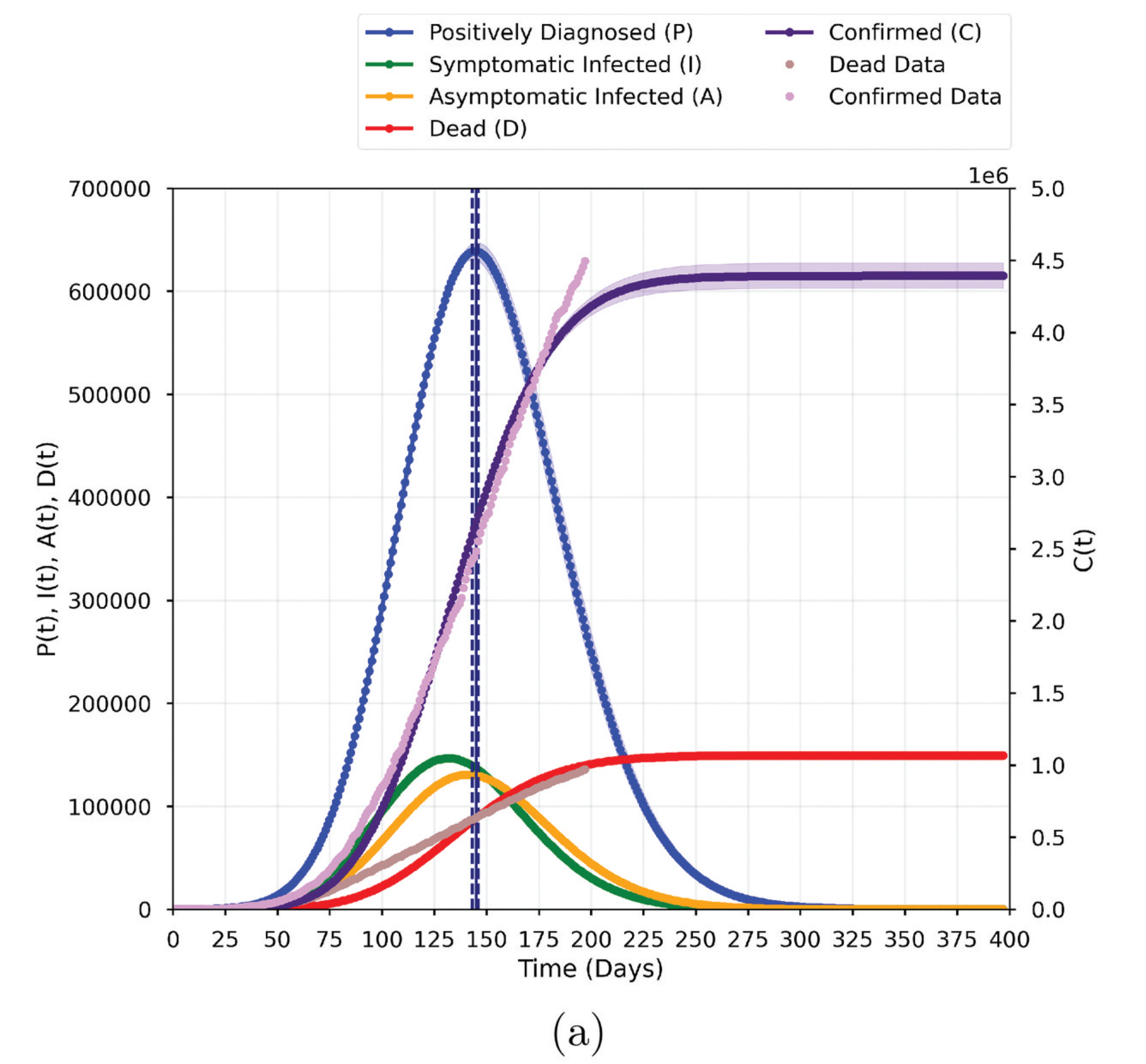
Time series for SEIRD model compartments, with observed cases and deaths and credibility bands around predictions.
Epidemiological model applied to Brazil using 2020 data. Curves use maximum a posteriori (MAP) estimates, with 95% credible intervals.
Volpatto et al. (2021, online publication), Fig. 3(a)View full-size figure

© 2026 Diego Tavares Volpatto · LNCC / MCTI

Built with SciAstro

Original text: CC BY 4.0. Code: MIT. Logos and third-party materials retain their own terms. Licensing and credits.